Toolbox Talks for Warehouses and Logistics: Preventing Fatal Injuries
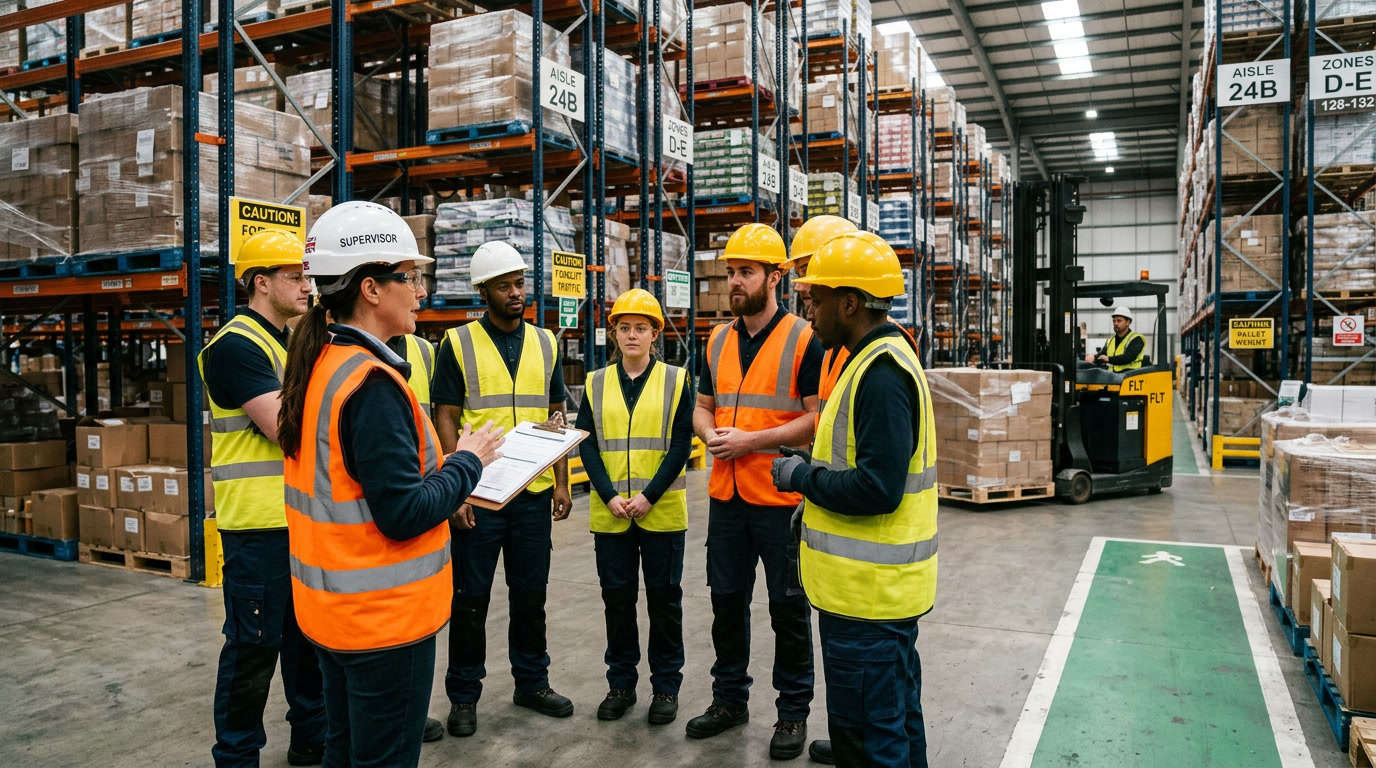
Every year, warehousing and logistics operations see some of the UK's highest workplace injury rates. HSE statistics show this sector has one of the highest rates of major injury per worker — with forklift incidents being the largest cause of warehouse fatalities and manual handling injuries the most common non-fatal harm.
The solution isn't complex or expensive. High-performing warehouse operations use daily toolbox talks to keep safety front of mind before shifts begin. These brief, focused discussions tackle the specific risks your teams face and can dramatically reduce incident rates.
Why Warehouses Need Targeted Safety Communications
Warehouses present multiple serious hazards that interact dangerously: moving machinery, heavy loads, height risks, and vehicle-pedestrian conflict zones. Unlike office environments, a moment's inattention can be fatal.
You have legal duties under the Health and Safety at Work Act 1974 to provide information, instruction, and training to protect your workers. The Management of Health and Safety at Work Regulations 1999 require you to ensure employees receive adequate health and safety training.
Toolbox talks aren't just good practice — they're a practical way to meet these legal obligations whilst addressing the real risks your operation faces daily.
The Major Warehouse Risks That Kill and Injure
Forklift Incidents — The Leading Killer
Forklift trucks cause more warehouse fatalities than any other single hazard. Common scenarios include:
- Tip-overs — trucks overturning due to speed, uneven surfaces, or improper loading
- Falling loads — crushing operators or nearby workers
- Pedestrian strikes — particularly at blind corners and intersections
- Falls from height — workers riding on forks or standing on pallets
Under the Provision and Use of Work Equipment Regulations 1998 (PUWER), you must ensure lift trucks are suitable, properly maintained, and operated only by trained, authorised personnel. Regular forklift safety toolbox talks reinforce these requirements and keep safety awareness high.
Manual Handling Injuries — The Most Common Harm
Back injuries, strains, and musculoskeletal disorders dominate warehouse accident books. The Manual Handling Operations Regulations 1992 require you to avoid hazardous manual handling where reasonably practicable, assess remaining risks, and train workers in safe techniques.
Key risk factors in warehouses include:
- Repetitive lifting of heavy items
- Awkward postures when accessing high or low storage
- Team lifting without proper coordination
- Rushing to meet picking targets
Understanding your manual handling obligations helps you design effective training programmes. Regular toolbox talks should cover proper lifting technique, when to use mechanical aids, and recognising when loads exceed safe limits.
Racking Collapse — Catastrophic Consequences
Warehouse racking systems store enormous weight at height. When they fail, the consequences are devastating. Common causes include:
- Forklift impact damage to uprights
- Overloading beyond safe working loads
- Missing or damaged bracing
- Uneven loading creating instability
PUWER requires regular inspection of racking systems. Your racking safety briefings should teach workers to spot damage, report impacts immediately, and understand loading limits.
Loading Bay Accidents
Loading bays are high-risk zones where vehicles, pedestrians, and lifting equipment interact. Serious injuries occur from:
- Falls from loading platforms
- Being struck by reversing vehicles
- Trailer separation during loading
- Dock leveller failures
The Workplace (Health, Safety and Welfare) Regulations 1992 require safe access, adequate lighting, and protection from falls. Loading bay safety talks ensure teams understand traffic management systems, personal protective equipment requirements, and emergency procedures.
Implementing Warehouse Toolbox Talks
When and How Often
Most effective warehouse operations run toolbox talks:
- Pre-shift — 5-10 minutes before work begins
- Daily — different topics on a rotating schedule
- After incidents — immediate response to near misses or accidents
- When risks change — new equipment, procedures, or seasonal hazards
Brief is better. Workers in fast-paced environments respond better to focused, practical messages than lengthy presentations.
Essential Topics for Warehouse Operations
Your toolbox talk programme should cover:
- Forklift and mobile equipment safety — daily checks, speed limits, pedestrian awareness
- Manual handling techniques — proper lifting, team lifts, when to use aids
- Racking inspection and loading — spotting damage, weight limits, even distribution
- Loading bay procedures — vehicle restraints, edge protection, banksman duties
- Pedestrian safety — designated walkways, high-vis clothing, hazard awareness
- Fire prevention — housekeeping, hot work permits, emergency procedures
- slips, trips and falls and falls — spillage response, good housekeeping, proper footwear
- Working at height — ladder safety, MEWP procedures, fall protection
Making Talks Effective
Successful warehouse toolbox talks share common features:
- Relevant examples — use incidents from your industry or similar operations
- Interactive elements — ask questions, encourage discussion of near misses
- Visual aids — photos of good and bad practices, damaged equipment
- Clear actions — what workers should do differently today
- Documentation — record topics covered and attendance
Learn more about delivering effective toolbox talks that engage teams and change behaviour.
Legal Requirements and Record Keeping
Under the Management of Health and Safety at Work Regulations 1999, you must keep records of safety training provided. For toolbox talks, this means:
- Topics covered and dates
- Attendance records
- Key points discussed
- Actions arising
These records demonstrate compliance during HSE inspections and help identify knowledge gaps. Understanding your record keeping obligations ensures you meet legal requirements whilst building an effective safety culture.
Managing Specific Warehouse Hazards Through Training
Vehicle-Pedestrian Segregation
Effective warehouse layouts separate vehicles from pedestrians wherever possible. Where interaction is unavoidable, clear procedures and training are essential. Your traffic management talks should cover:
- Designated walkways and crossing points
- Banksman procedures for reversing vehicles
- High-visibility clothing requirements
- Speed limits and no-go zones
Fire Risks from Stored Goods
Warehouses often store large quantities of combustible materials. Fire spreads rapidly in these environments, making prevention critical. Key topics for fire safety talks include:
- Housekeeping to prevent ignition sources
- Hot work permit procedures
- Storage arrangements and fire breaks
- Emergency evacuation procedures
Ensure your team understands fire prevention fundamentals and their role in emergency response.
Equipment Inspection and Maintenance
PUWER requires daily checks of lifting equipment and regular thorough examination by competent persons. Workers need to understand:
- What to check before using equipment
- How to report defects immediately
- Why damaged equipment must be taken out of service
- The consequences of using faulty machinery
Your equipment inspection talks turn legal compliance into daily practice.
Ready-Made Warehouse Toolbox Talks
Creating effective toolbox talks from scratch takes significant time and expertise. Professional content ensures you cover the right topics with accurate, engaging material.
Our Warehouse & Logistics Safety Bundle provides 25-30 ready-to-use talks covering all major warehouse hazards. Each talk includes presenter notes, discussion points, and follow-up actions — everything you need to run professional safety briefings.
Individual talks are also available for specific hazards:
- Forklift & Pedestrian Safety
- Manual Handling in Warehouses
- Racking & Storage Safety
- Safe Stacking & Storage
- Safe Use of Pallet Trucks
Measuring Success and Continuous Improvement
Effective toolbox talk programmes show measurable results:
- Reduced incident rates — fewer accidents and near misses
- Increased reporting — workers more willing to report hazards
- Better housekeeping — visible improvements in workplace organisation
- Engaged workforce — active participation in safety discussions
Track these metrics monthly and adjust your programme based on results. If forklift incidents remain high, increase the frequency of equipment safety talks. If manual handling injuries persist, focus on technique and risk assessment training.
When You Need Professional Help
Toolbox talks are one element of a comprehensive safety management system. You may need professional assistance for:
- Comprehensive warehouse safety assessments
- PUWER compliance reviews for lifting equipment
- Manual handling assessments using scientific tools
- Fire risk assessments for complex storage arrangements
- Training needs analysis for your specific operation
Understanding your broader safety obligations helps you identify when expert support adds value.
What to Do Now
Start improving warehouse safety immediately with these actions:
- Review recent incidents — identify the hazards causing actual harm in your operation
- Plan a talk schedule — rotate through key topics over 4-6 weeks
- Train supervisors — ensure they can deliver engaging, accurate briefings
- Set up record keeping — document topics, attendance, and outcomes
- Monitor results — track incident rates and worker feedback
The cost of daily safety briefings is minimal compared to the human and financial cost of warehouse accidents. Don't wait for a serious incident to act — start building a stronger safety culture today.
Need Help?
If you're unsure how to implement an effective toolbox talk programme or need help addressing specific warehouse hazards, get in touch. We can help you develop a tailored approach that fits your operation and reduces your risk.
Browse our full library of 100 ready-to-use toolbox talks — editable Word format, attendance register included, aligned with UK health and safety legislation. From £3.99.